What counts as a YouTube collaboration
A YouTube collaboration is any deliberate content partnership between two or more creators where both channels participate in promotion. The defining trait is mutuality. A guest appearance on a podcast is a collaboration. A creator paying you to mention their channel is a sponsorship, not a collaboration. A Shorts duet where both creators tag each other in the caption is a collaboration. A re-upload of someone else's footage without their input is not. On CollabPals, every listing is explicitly framed as a mutual-benefit arrangement. The platform exists to coordinate the discovery and matching step, which is the part most creators say is hardest.
Why YouTube collaborations work
YouTube's recommendation system tracks which channels share audiences. When two creators collaborate, both channels send strong signals: shared viewers, cross-channel watch sessions, and reciprocal subscribe activity. The algorithm interprets that pattern as evidence that the two channels appeal to overlapping audiences, then surfaces them in each other's recommended-video shelves more aggressively. That second-order effect is often larger than the first-order spike from the collaboration video itself. CollabPals data on its own marketplace shows that creators who run three or more collaborations across a quarter consistently report stronger recommended-video traffic than creators who run zero, independent of any single collaboration's view count.
The seven core YouTube collaboration formats
CollabPals Collaborations organizes listings into seven canonical formats: joint videos, guest appearances, Shorts collaborations, challenge videos, series collaborations, live streams and premieres, and Featured Channel exchanges. Each format has different production overhead, different audience-overlap requirements, and different growth profiles. A joint video produces the highest-leverage single upload but requires the most coordination. A Shorts duet ships in an hour but lives or dies on a single hook. A Featured Channel exchange takes thirty seconds to set up and compounds quietly for months. Read each format's dedicated landing page on CollabPals to see open listings, recent examples, and format-specific notes.
How creators find a YouTube collab partner
Four channels dominate partner discovery: cold-DMing creators whose videos you watch, posting in collaboration Discord servers, replying to comment threads from creators looking for partners, and using a dedicated collaboration marketplace like CollabPals Collaborations. The first three are unpredictable and slow because most established creators receive dozens of unsolicited collab pitches a week and ignore the majority. The fourth is faster because every listing on CollabPals is an explicit signal from a creator who wants to collaborate right now. The deep-dive guide on how to find a YouTube collab partner walks through each channel and explains when to use which.
Twelve YouTube collab ideas that actually work
Collaboration ideas fall into three rough effort tiers. Low-effort ideas (Featured Channel exchanges, comment shoutouts, Shorts response chains) take under thirty minutes total and produce slow steady cross-pollination. Medium-effort ideas (guest appearances, podcast swaps, Shorts duets) take a few hours and produce a noticeable single-upload spike plus algorithm signal. High-effort ideas (joint videos, series collaborations, live-stream premieres) take days to weeks and produce the largest mutual lift but also the highest coordination cost. The dedicated YouTube collab ideas guide on CollabPals lists all twelve with format, audience-overlap requirement, and the kind of partner each works best with.
Shorts collaborations are different
Shorts collaborations move on a different rhythm than long-form. A Shorts duet, response chain, or shared-concept video can be filmed in a single afternoon and uploaded the same day by both creators. The Shorts feed is also less anchored to subscriber count than the main YouTube feed, which means a small creator collaborating with a larger one can show up in the same feed slot. The Shorts collab guide on CollabPals walks through the five patterns that actually work (duet, response, chain, parallel, follow-up), the sixty-second filming rule that breaks them, and how to coordinate the two uploads so the algorithm reads them as paired.
Joint videos: the highest-leverage format
A joint video is two creators co-starring in one video, published once or twice (one on each channel, or one combined upload with cross-promotion on the other). Joint videos produce the largest cross-channel audience transfer because viewers watch both creators in the same frame, building familiarity that converts to subscribes more reliably than any other format. They also require the most coordination: a shared concept, aligned filming logistics, agreed-on edit ownership, and a coordinated publish date. The dedicated joint video collab guide on CollabPals covers the seven-step production flow that keeps both creators aligned and surfaces the three failure modes that derail most attempts.
Matching collab partners by subscriber tier
Subscriber-count compatibility matters more than most creators realize. A pairing where one channel has ten times the subscribers of the other tends to deliver lopsided value: the larger channel gives more than it receives, so the partnership rarely repeats. The most successful pairings on CollabPals fall within a two-to-three-times range on either side of each creator's subscriber count. CollabPals Collaborations exposes this through three dedicated facet pages so creators can browse only listings open to their tier: small creators under 10,000 subscribers, mid-tier between 10,000 and 100,000, and established creators at 100,000 and above. Trending listings rank by combined views and responses across all tiers.
Planning the collaboration: the four agreements that prevent failure
Most failed YouTube collaborations break at the same four points. First, the concept: both creators must agree on a single sentence summary before any filming. Second, the format and ownership: who edits, who uploads where, who owns the master files. Third, the publish date: both uploads should hit within a forty-eight-hour window so the algorithm reads them as paired. Fourth, the cross-promotion plan: both creators commit in writing to a specific cross-promo (Featured Channel slot, pinned comment, end-screen card, or community post). CollabPals Collaborations threads keep this conversation in one place so both creators have a written record of what was agreed.
After the collaboration: turning one upload into a partnership
The biggest mistake creators make is treating a collaboration as a one-time transaction. The compounding value lives in the second, third, and fourth collaboration with the same partner. Once you have run a successful collab, add the partner to your Featured Channels, pin their comment, and propose a follow-up within thirty days while the algorithm signal is still fresh. CollabPals tracks every collab thread inside the mailbox, so finding a past partner and re-opening the conversation takes a single click. Creators who run repeat collaborations with the same two or three partners across a year typically report the strongest sustained channel growth, not creators who chase one-off pairings.
Getting started on CollabPals Collaborations
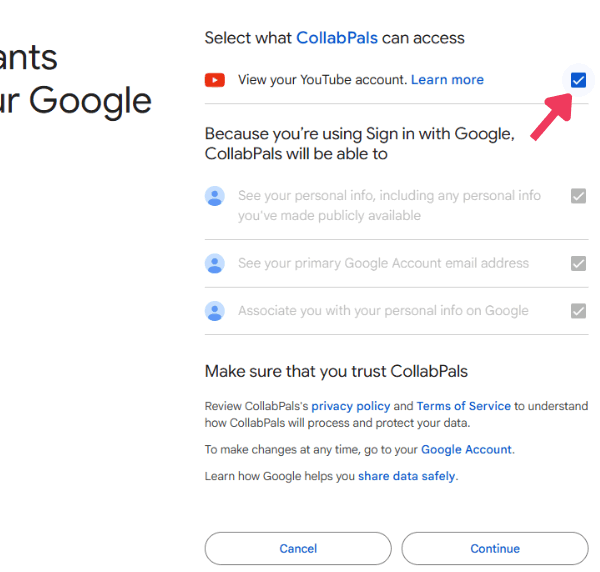
Browsing open collaboration listings on CollabPals is free and requires no account. Responding to a listing or posting your own requires a verified YouTube channel through Google OAuth, which keeps the platform free of fake accounts. There is no platform fee on any collaboration. Paid plans on CollabPals unlock additional listing slots and AI tools for content optimization, but the core collaboration marketplace is fully free at every subscriber size. The fastest start is to browse the trending facet, see what kinds of pitches are currently working, then post your own listing using the same shape.